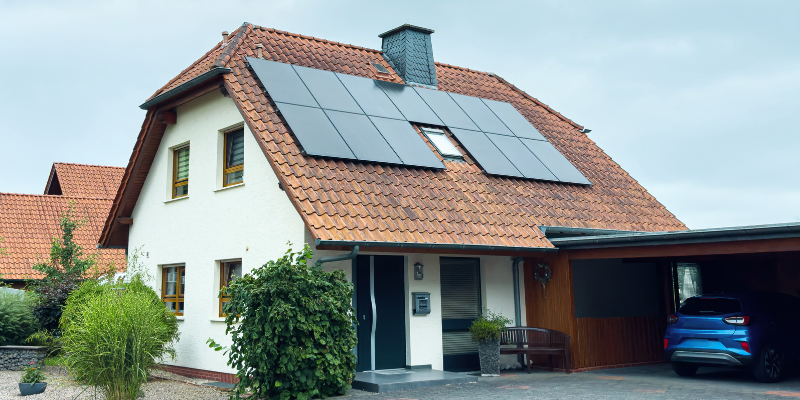
A woman in Elyria called me on a Wednesday morning. Three months behind on her mortgage, an auction notice already sitting on her kitchen counter with the date printed on it. Her husband had passed. The home held more equity than debt, and she needed someone to cut through the noise fast. What she hadn’t counted on was the owned solar system over her head lifting her home value more than she thought. We closed before the auction date. She had found us while looking for cash home buyers in Elyria. Solar’s least-told story is that one: it can help a seller in a financial bind, not only the homeowner chasing a greener roofline.
Does Solar Actually Help You Sell Faster
The solar price premium is well documented. The speed advantage mostly isn’t, and you deserve that straight before you price your home around it.
A 2025 SolarReviews study went through more than 400 recently sold Zillow listings across 36 states and 62 cities. Solar homes sold at a 6.9% premium over comparable homes without panels. That premium comes from closed transactions in real markets, not a survey.
Speed is where the popular claim falls apart. You’ve probably read that solar homes sell 20% faster, credited to the National Renewable Energy Laboratory. I went looking for that study. The report everyone links to, a 2006 San Diego case study, carries no days-on-market comparison at all. The 20% figure appears to have been invented somewhere across two decades of blog citations.
Zillow ran the largest look at selling speed, covering 3.1 million closings across 2020 and 2021. Solar panels landed at 2.6 days slower than average, not faster. EV charging stations moved homes 9.5 days faster. Panels never made that list.
So why does the money show up when the clock doesn’t? Buyers slow down to read. A solar system arrives with production history, warranty terms, and an ownership question that takes a phone call to settle. Two and a half days is the cost of that reading. A buyer taking time isn’t a buyer losing interest.
Agents live inside the same split. In the National Association of Realtors 2025 Residential Sustainability Report, 58% called promoting energy efficiency in a listing very or somewhat valuable. Yet 48% said solar panels make a home harder to sell. Both readings hold at once, and ownership is what usually separates a valuable solar home from a complicated one.
I’ve bought homes in and around Lorain County for years. An owned solar system has never slowed a closing on my end. Solar leases are the ones that eat weeks. Own your system outright, and you’re holding an asset buyers can price. Sit on a lease or a power purchase agreement, and the picture changes. That’s the same read I bring when we buy houses in Lorain, OH, for cash, panels or no panels.
Key Findings From Our Research
Most articles bury the ownership question in a paragraph at the bottom. It belongs at the top. Whether you own your solar system or rent it from a third party moves your selling price, your days on market, and the number of buyers who can qualify for your home at all.
SolarReviews put its solar premium at nearly $29,000 on a home around $416,900. That price was the median for a new single-family home in early 2025, per Census and HUD, not the figure for existing homes, which landed at $414,400. Roughly seven percent on a home in that range still lands near thirty grand, and that premium belongs in your asking price.
Solar Insure studied California alone. It matched 5,000 homes sold between 2020 and 2023, pairing each solar home with three nearby non-solar homes of comparable size, age, and features. Owned solar systems sold for 5% to 10% more. Leased systems sold for no more than their panel-free neighbors. That second finding is the one to keep on a sticky note.
The United States now holds more than 6 million solar installations, according to the Solar Energy Industries Association. It crossed 5 million in May 2024 and took two years to add the next million. Your buyer has seen panels before.
One thing catches solar sellers off guard. Appraisers vary widely, and agents know it. In that same NAR report, 73% weren’t sure whether appraisers in their market are trained on the added value of sustainability features. Another 52% flagged solar system valuation as a gap in their own knowledge. Ask your agent before you list, not after a low appraisal lands on a home you already have under contract.
How We Calculated the Solar Price Premium
Credible studies use matched-pair analysis. You take a solar home, find a nearby home without panels that sold around the same time and looks comparable on paper, then measure the gap between the two closings. Solar Insure’s California work is a clean example, and three comps per solar home is what keeps a fancy kitchen from being mistaken for a solar premium.
The spread across studies isn’t sloppiness. Local electricity costs and net metering rules drive most of it. A solar premium worth double digits in one state rounds toward zero two states over, because what buyers price is the monthly savings, not the hardware.
EnergySage, a solar comparison marketplace, publishes system cost and value data down to the zip code. Lawrence Berkeley National Laboratory has peer-reviewed paired-sales research on solar premiums going back years. Either one beats a generic calculator if you want a number tied to your own market value rather than a national premium.
How Much Do Solar Panels Increase Home Value?
A seller in the Cleveland suburbs listed last spring with a 7 kW solar system installed two years earlier. Their agent buried the production data in the disclosure packet. The home sold for about 3% over nearby comparables. Stronger presentation would likely have moved that number, because an agent who can market a documented solar system is selling something specific.
System size, condition, local electricity rates, and the original financing all feed into what a solar panel system adds to home value. None of it is fixed. That’s why the premium runs from nothing to double digits, depending on your state and your market.
The U.S. Department of Energy puts it plainly. Solar panels get viewed as upgrades, the way a renovated kitchen or a finished basement does, and buyers paid about $15,000 more for a home with an average-sized solar array. That worked out to about four dollars per watt on a 3.6 kW system. The research covered owned systems only and dates to 2015, so treat that premium as a floor rather than a forecast.
Younger buyers get credit for driving all this, and the truth is narrower. Younger millennials and Gen Z carry the highest first-time buying rates, 60% and 55% within their own age groups. Energy efficiency still doesn’t top their lists. Heating and cooling costs were rated very important to 43% of Gen Z buyers, while solar panels drew 3% of all buyers naming them very important. Solar helps a seller. It rarely decides the outcome alone.
Documented output beats installed capacity every time. Show a buyer 12 months of real kWh readings, and you’re having a different conversation than pointing at a roof.
Will You Recoup the Cost of Solar When You Sell?
For years I assumed the math always favored the seller. It usually does. Automatic, it is not.
A 10 kW solar system costs about $25,800 before incentives in 2026, based on EnergySage pricing of $2.58 per watt. Typical systems have grown, and 12 kW sits closer to the norm now at roughly $31,000.
The federal picture changed hard. Section 25D, the residential clean energy credit, no longer applies to expenditures made after December 31, 2025. That came out of the 2025 reconciliation law, Public Law 119-21, the one most people call the One Big Beautiful Bill Act. A homeowner buying a solar system today gets no 30% credit.
One detail trips people up. The cutoff turns on when installation is finished, not when you paid. Pay in December, finish in January, and you get nothing per IRS guidance. You can read the IRS page on the residential clean energy credit yourself.
That shift helps solar sellers more than it hurts them. A buyer comparing your solar home against installing new on a cheaper house no longer gets three-tenths of the cost back from the government. Your existing system just became relatively more attractive, and that premium shows up in what buyers will pay.
Recoupment depends on how long the solar system has been yours. Install five years ago and sell now, and you’ve banked years of utility savings on top of whatever premium the market adds. Install six months before listing, and the math thins out, because you paid current costs and captured almost none of the savings.
Owned Vs. Leased Solar Panels: How Each Affects Your Sale
Sellers push back on this one constantly. My payments are low, and my electric bill is zero, so why would a buyer care who holds title to the system?
Because the buyer’s lender cares, and your buyer has to satisfy the solar company’s credit standards on top of the mortgage company’s. That is a second underwriting nobody warned them about.
Solar leases and power purchase agreements typically run 20 to 25 years. Your buyer has to take over the lease and pass that separate credit check. Most mortgage-qualified buyers clear it. The extra step still adds friction, and some buyers won’t sign a 20-year agreement they had no hand in writing. I’ve watched a closing stall at the finish line over exactly that.
Third-party ownership isn’t a niche anymore. Wood Mackenzie put solar leases and PPA arrangements at 45% of the residential market for 2024 as a whole, and above half in the fourth quarter, the first time since 2016. Installer surveys across the country point to higher lows through 2026. With the homeowner credit gone and leasing companies still able to claim a commercial credit, more sellers and buyers will face this than fewer.
Leased solar panels typically add no premium to your selling price while narrowing your buyer pool. If you’re on a solar lease and heading toward a sale, the cleanest path is often paying off the remaining term first. Lease buyouts get priced at fair market value, and no honest range exists, because contracts differ enormously. One reported case had a seller owing more than $60,000 on the panels. Ask your solar company for the payoff figure early, well before it turns into a surprise line at closing.
At Lorain County Homebuyers, we buy homes with solar in any configuration, owned or leased, and we can help you sort out which path fits before you commit to anything. You can read how we work with homeowners and decide for yourself whether that fits your situation.
Does a Solar Home Sell Faster Than a Non-solar Home?
On the whole, no. Solar homes don’t sell faster in any measurable way on the strength of the panels alone.
That verdict carries a real caveat. A transferred solar lease can absolutely make a home sit longer, because your buyer pool shrinks to buyers willing to run the extra lease qualification. An owned solar home carries none of that drag, and can close faster, which is why ownership keeps coming back around.
What actually helps a home sell faster isn’t hardware. It’s a seller with an owned system, the savings documented, and the ownership question answered before the first buyer walks through. Picture a buyer touring two homes in one afternoon, one producing its own power and one not. Buyers feel the difference in the monthly bill, and feeling it early tends to produce an offer sooner.
Is solar already ordinary on your street, or still unusual? That answer shapes whether solar helps you sell faster in your own market.
Solar Home Sale Trends by State

Getting the state read wrong costs sellers money. Every state prices panels differently. Price an Alabama house off the national average, and you may sit for months wondering where the offers went.
Of the 36 states in the SolarReviews dataset, four came in under a 2% solar premium. Alabama went the other direction, where non-solar homes sold for about 5% more than comparable solar homes. New York led everybody with a 10.8% premium. Kentucky and Michigan followed at 9.8% and 9.2%. Massachusetts anchored the positive end at 0.8%.
Market saturation explains part of that spread. Once panels show up on half the block, they stop adding value and start reading as normal. California, the most saturated solar market in the country with roughly 2 million installations, still posted a 6.1% premium.
Ohio isn’t in that state-level dataset, and the local picture earns its own paragraph. Electricity here is no longer cheap. Ohio residential rates hit 19.19 cents per kWh in June 2026 against a national average of 18.34 cents, after climbing about 10% in a single year. Rising bills are what make a working solar system valuable to the buyer of your home. Solar adoption around Lorain County keeps growing without saturating a single subdivision, so an owned system still stands out on a listing sheet. The team at Lorain County Homebuyers walks these properties every week and can give you a realistic read on what your solar array adds to your home value locally. The statewide picture matters here too, and as cash house buyers in Ohio, we see the same rate pressure showing up well outside Lorain County.
Property tax is the other piece worth raising with a nervous buyer. SEIA counts 36 states with some form of solar property tax exemption, Ohio among them, where systems of 250 kW or less are exempt from utility property taxation under state law. A residential rooftop solar array sits nowhere near that ceiling.
Solar Home Sale Trends in Major Cities
City markets scatter more than state numbers, and SolarReviews counted 62 markets.
Little Rock topped the list at 13.1%. Albany came second at 10.8%. Ann Arbor hit 8.0%, Seattle 7.2%, Baltimore 7.0%. Then the floor gives way. Charlotte managed 5.6%, Portland 4.8%, Omaha 1.7%, Atlanta 0.1%. Chicago sold at a negative 0.3% premium.
No tidy pattern connects the winners. Electricity costs matter, appraiser familiarity matters, and so does how many roofs on the street already carry solar. Little Rock is nobody’s idea of a big solar market. That’s arguably the lesson. Scarcity plus a documented electric bill is a strong value combination for a buyer.
Cleveland and Columbus didn’t make the city list, and Midwest appraisers are generally still catching up on how to value a system against comparables. Sellers here sometimes have to push during the appraisal with production records in hand. Not long ago, I looked at a duplex in Lakewood where the landlord was done chasing rent. Three years of the previous owner’s solar paperwork sat stacked in the garage, output logged month by month. That stack did more for the listing than any brochure could have. The same appraisal gap shows up when we buy houses in Cleveland with panels already on the roof.
If you’re unsure where your solar system lands in your own market, or you’d rather skip the appraisal question, Lorain County Homebuyers makes cash offers on solar and non-solar homes alike. No agent fees, no repairs asked for, no guessing about what your panels add in value for a traditional buyer. Connect with our Lorain County team when you want that number, and we’ll tell you what we’d pay.
Frequently Asked Questions
Is It Harder to Sell a Home with Solar Panels?
Ownership decides it. Owned solar panels rarely create a problem and usually help your sale price. Solar leases and power purchase agreements are the harder case, since your buyer has to qualify with the solar company to take over the contract, which adds friction and occasionally sinks a sale. Agents are split on the question, and lease transfers are a large part of why. An owned panel system, free and clear, makes an asset every buyer understands.
What Is the 33% Rule for Solar Panels?
This one needs correcting. Plenty of pages claim a 33% rule means solar adds a third of its installation cost back at resale. No appraisal standard, trade body, or research group recognizes any such rule. A real 33% rule does exist in solar, and it has nothing to do with home value. Fire codes use a 33% roof coverage threshold to set how much clearance an array needs at the ridge, which keeps access paths open for crews. For a defensible value number, use the per-watt solar premium from Lawrence Berkeley National Laboratory’s paired-sales research.
Do Houses with Solar Sell for More Money?
In most markets, yes. The 2025 SolarReviews figure of just under seven percent is the best current read, and solar homes sold higher across most of the 36 states studied. Solar premiums track local electricity costs, which is how New York outran Massachusetts by ten points. Ownership is the dividing line again. Owned solar systems carry the premium, while leased systems add no measurable value to the sale price.
What Is the Biggest Drawback of Solar Panels for Home Sellers?
A leased solar system with a long remaining term. Your buyer qualifies separately with the solar company. Some buyers won’t take on a two-decade lease they didn’t negotiate, and that step can delay or sink a closing. Bought and paid off, there’s very little downside at sale time. If the lease still has 15 years to run, get the payoff figure from your solar company before you list.
Selling a home with solar isn’t complicated, though it does require knowing what you have. Ownership, local electricity costs, and how the paperwork gets handled decide whether your solar system helps you, slows you down, or barely registers. If you want to talk it through, we’re here. No pressure, no obligation.
Helpful Lorain Blog Articles
- How to Do a Sale by Owner in Lorain, OH
- Selling a Home That Needs Repairs in Lorain, OH
- How to Sell an Inherited House in Lorain, OH
- Home Appraisal Before Closing in Lorain, OH
- Selling a House With Foundation Issues in Lorain, OH
- Can You Sell a House As-Is Without Inspection in Lorain, OH?
- Homeowners Insurance When Selling a House in Lorain, OH
- Do I Need a Lawyer to Sell My House in Lorain, OH?
- Selling a Home with a Reverse Mortgage in Lorain, OH
- Do I Need to Paint My House in Lorain, Ohio, to Sell it?
- Can I Sell My House in Lorain, OH If I Have Equity Release?
- Can Heir Property Be Sold in Lorain, OH?
- Do Homes with Solar Sell Faster